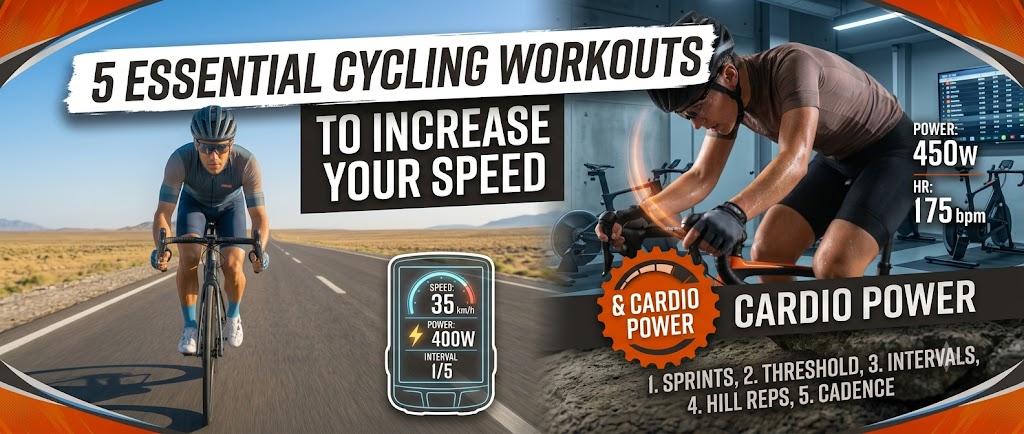
If your weekly training routine consists entirely of stepping out your front door and cycling at the exact same relaxed, comfortable cruising speed day after day, your body will rapidly adapt. While this slow riding is fantastic for building a strong aerobic base, it teaches your muscles to operate efficiently only at that specific slow velocity. If you want to ride a faster century, keep up with fast group rides on the highway, and break your personal records, you must train your heart and legs to handle higher workloads.
Cycling sports science proves that by systematically altering your pedaling cadence, incorporating vertical hill climbs, and implementing structured intervals, you can dramatically expand your cardiorespiratory fitness. These high-speed workouts increase your heart's stroke volume, train your body to clear metabolic waste, and build powerful lower body muscles. Here are the five essential cycling workouts designed to safely maximize your speed and power.
The Non-Negotiable 10-Minute Dynamic Cycling Warmup
Never jump straight into an intense speed workout with cold, tight leg muscles and stiff joints. Sprinting with tight muscles can instantly cause a severe hamstring or calf strain.
Spend 10 minutes performing a relaxed, easy spin in a light gear, maintaining a quick cadence above 90 RPM to get blood flowing to your legs. Next, perform 3 short, 15-second "spin-ups"—accelerating your feet up to 110 RPM without rocking your hips on the saddle. This simple sequence alerts your nervous system and prepares your joints for the high-intensity work ahead.
1. High-Intensity Tabata Sprints (The Cardiovascular Booster)
This high-intensity workout utilizes short, explosive bursts of absolute maximum power to aggressively raise your heart rate, forcing your body to expand its lung and oxygen capacity rapidly.
- The Workout: Find a flat stretch of road. Shift into a medium gear, stand up out of the saddle, and sprint at 100% of your maximum physical capacity for exactly 20 seconds. Drop back down to the saddle and spin very gently for 10 seconds to recover. Repeat this intense cycle 8 times consecutively for a total of 4 minutes. Perform two full sets of this workout, taking a 5-minute easy ride between sets.
- Why it Works: Tabata intervals rapidly expand your VO2 max (maximum oxygen intake limit) while building explosive fast-twitch muscle fibers throughout your calves and quads.
2. Sweet-Spot Threshold Blocks (The Pure Endurance Builder)
Sweet-spot training targets an intensity right below your lactate threshold, making it the most efficient way to build long-distance cruise speeds without causing deep muscle burnout.
- The Workout: After warming up, accelerate up to a steady, challenging pace that sits at an effort level of 8 out of 10. You should be breathing deeply and only able to speak short phrases. Maintain this exact intensity for 15 minutes continuously. Spin easily in a light gear for 5 minutes to recover, then execute a second 15-minute block.
- Why it Works: This workout teaches your body to clear away lactic acid efficiently while moving fast, allowing you to sustain aggressive running speeds for hours without experiencing leg burn.
3. High-Cadence Spin Intervals (The Pedaling Efficiency Catalyst)
This workout targets your brain's neuromuscular connections, eliminating bouncing on the saddle and training your feet to deliver smooth, round strokes.
- The Workout: Find a flat road or use an indoor bike trainer. Shift into a light, easy gear. For exactly 5 minutes, force your legs to spin at a high cadence between 100 and 110 RPM. Your goal is to maintain this fast foot speed without shifting gears or letting your hips rock side to side. Ride easily at 90 RPM for 3 minutes to recover, and repeat the sequence 4 times.
- Why it Works: High-cadence work teaches your muscles to contract and relax faster, which improves your overall pedaling efficiency and saves valuable muscle glycogen on long endurance paths.
4. Big-Gear Incline Hill Climbs (The Pure Leg Strength Builder)
Riding up a steep incline forces your lower body to fight directly against gravity, turning a standard cardio cycling session into a powerful strength workout for your joints and muscles.
- The Workout: Find a hill with a steady incline that takes roughly 3 to 4 minutes to climb. Shift into a heavy gear that forces your cadence down to 60-70 RPM. Stay seated on the saddle, brace your core, and push down hard through the pedals to climb to the top using pure leg strength. Coast slowly back down the hill to recover fully, and perform 5 repetitions.
- Why it Works: Seated big-gear climbing functions like a hidden leg press session, building immense strength throughout your glutes and quadriceps while protecting your joints from heavy impact stress.
5. The Fast-Finish Micro-Interval Long Ride (The Racing Simulation)
This advanced workout is designed to be integrated directly into your weekend long endurance ride, specifically targeting the final stages when your body is deeply fatigued.
- The Workout: Cover the first 80% of your scheduled long ride distance at a relaxed, easy baseline pace. However, during the final 5 kilometers of the ride, execute a fast 30-second sprint at the start of every single kilometer, returning immediately to your goal race pace between sprints.
- Why it Works: This challenging shift trains your brain and muscles to unlock fast speeds when your legs feel heavy like lead. It builds incredible mental confidence, proving to your mind that you have the power to finish a race strong even under deep fatigue.
Always remember the golden rule of speed work: schedule only one or two high-intensity speed sessions per week. Your body requires time to rebuild structural tissues after a hard workout. Follow every speed day with a dedicated rest day or an incredibly easy recovery walk to ensure you continue progressing safely without facing injury.
 Back to Blog