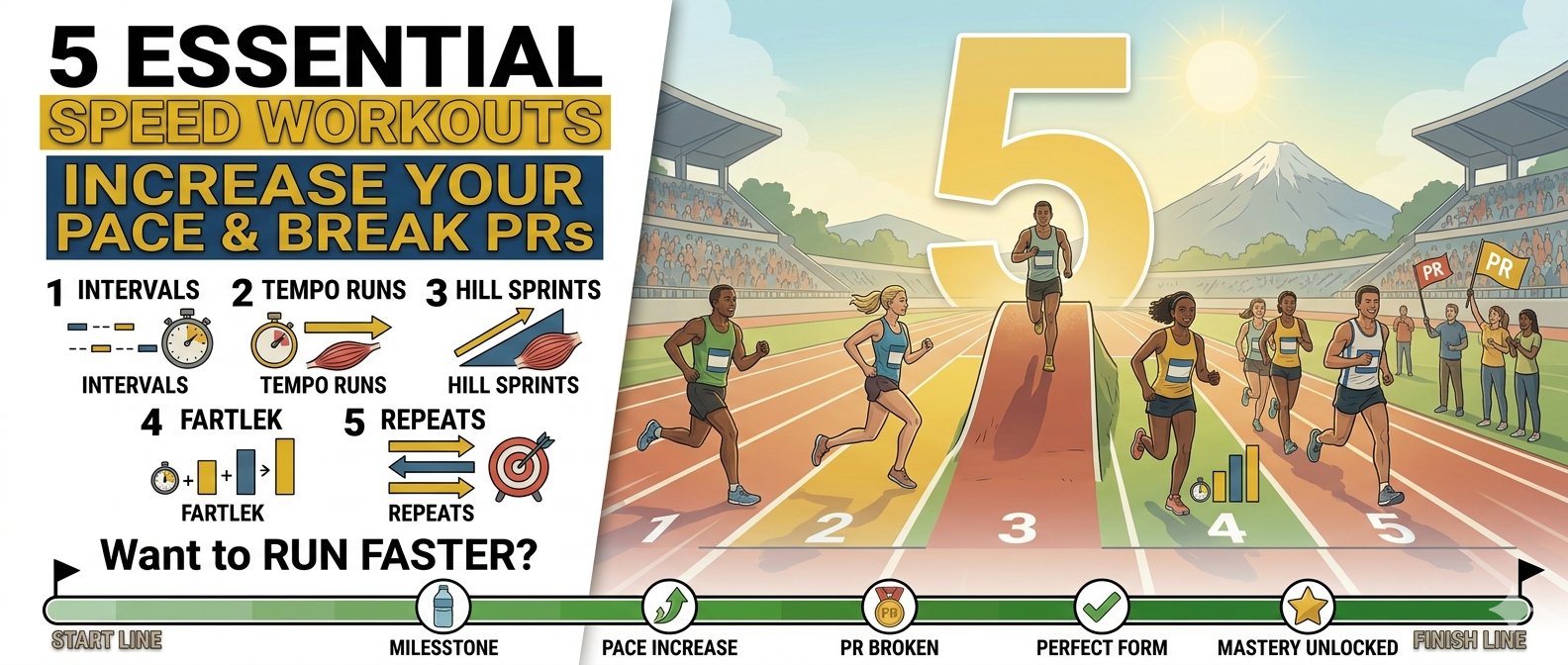
If your standard training routine consists entirely of stepping out your front door and jogging at the exact same relaxed, comfortable pace day after day, your body will rapidly adapt. While this slow running is fantastic for building a strong aerobic base, it teaches your muscles to operate efficiently only at that specific slow speed. If you want to run a faster 5K, 10K, or marathon, you must actively train your muscles and heart to handle faster velocities.
Speed training upgrades your heart's stroke volume, allowing it to pump more oxygen-rich blood with every single beat, while building powerful fast-twitch muscle fibers. However, high-speed running places intense stress on your body and must be executed with a highly structured, intelligent plan to prevent injuries. Here are the five essential speed workouts every runner needs to unlock their true potential.
The Non-Negotiable 15-Minute Dynamic Warmup Protocol
Never jump straight into an intense speed workout with cold, stiff muscles. Sprinting with tight muscles can instantly cause a severe hamstring pull or calf tear.
Spend 10 minutes performing a very slow, gentle jog to raise your core body temperature. Next, spend 5 minutes performing dynamic flexibility movements:
- Leg Swings: Swing each leg forward and backward 15 times to loosen up your hips.
- High Knees: Drive your knees up toward your chest to activate your hip flexors.
- Butt Kicks: Jog in place while bringing your heels up to strike your glutes, stretching your quads.
- Walking Lunges: Step forward into a deep lunge to wake up your glutes and hamstrings.
1. Classic Track 400-Meter Intervals (The VO2 Max Booster)
This traditional workout is best executed on a standard 400-meter running track to ensure absolute accuracy, but it can also be performed on any flat, straight stretch of road using a GPS smartwatch.
- The Workout: After your warmup, sprint at an intense pace for exactly 400 meters (one full lap around the track). Your speed should match your current 5K goal race pace. Next, rest completely by slowly walking or gently jogging for 2 minutes to let your heart rate drop. Repeat this sequence 8 times.
- Why it Works: This workout forces your lungs to operate at peak capacity, expanding your maximum oxygen processing limits while teaching your legs a fast, efficient cadence turnover.
2. The Lactate Threshold Tempo Run (The Endurance Builder)
A tempo run is often described by professional running coaches as a workout that feels comfortably hard. It is a continuous effort that bridges the gap between raw speed and long-distance endurance.
- The Workout: Start with a 5-minute easy jog. Next, accelerate up to a steady pace that you can continuously sustain for 20 minutes without slowing down. On an effort scale of 1 to 10, this should feel like a solid 7. You should be able to speak only short, broken words, not full conversations. Finish with a 5-minute cool-down jog.
- Why it Works: Training at this specific boundary teaches your blood circulatory system to clear away lactic acid at the exact same rate it is produced, allowing you to run much faster for longer distances before your legs experience a burning sensation.
3. The Swedish Fartlek Session (The Speed Play Game)
Fartlek is a beautiful Swedish word that translates directly to speed play.This workout introduces fun, creative variety into your running routine by mixing fast bursts and slow recovery segments throughout a continuous run.
- The Workout: Head out for a standard 30-minute outdoor run. After warming up, pick an object in the distance, such as a bright red car, a specific tree, or a distant light pole. Accelerate aggressively and sprint fast toward that object. Once you reach it, drop your pace down to a very slow jog until your breathing feels completely calm. Repeat this playful process throughout the entire run, varying the distances and speeds of your fast segments.
- Why it Works: Fartleks teach your body to change gears fluidly, preparing you for actual race scenarios where you need to accelerate to pass a competitor or push up a steep hill.
4. Structured Hill Repeats (The Ultimate Leg Strength Builder)
Running up a steep hill forces your body to fight directly against gravity, turning a standard cardio session into a powerful strength workout for your lower body joints and muscles.
- The Workout: Find a hill with a moderate incline that takes roughly 45 to 60 seconds to run up from the bottom to the top. Sprint up the hill with maximum power, focusing on driving your knees high, keeping your posture tall, and pumping your arms forward. Use the slow, relaxed walk back down to the bottom of the hill as your complete rest period. Perform 6 to 8 repetitions.
- Why it Works: Hill repeats act like a hidden weightlifting session, building exceptional strength in your calves, quads, and glutes without exposing your joints to the heavy impact forces of flat road sprinting.
5. The Fast-Finish Long Run (The Mental Toughness Creator)
This advanced workout is designed to be integrated directly into your weekend long endurance run, specifically targeting the final stages of a race when your body is deeply fatigued.
- The Workout: Cover the first 80% of your scheduled long run distance at your standard, slow, relaxed baseline pace. However, as you enter the final 2 to 3 kilometers of the run, accelerate and push your pace down to match your competitive goal race speed. Finish the run at this high intensity.
- Why it Works: This workout trains your brain and muscles to unlock fast speeds when your body is exhausted. It builds incredible mental confidence, proving to your mind that you have the power to finish a race strong even when your legs feel heavy like lead.
Always remember the golden rule of speed work: schedule only one high-intensity speed session per week. Your body requires time to rebuild structural tissues after a hard workout. Follow every speed day with a dedicated rest day or an incredibly easy recovery walk to ensure you continue progressing safely without facing injury.
 Back to Blog