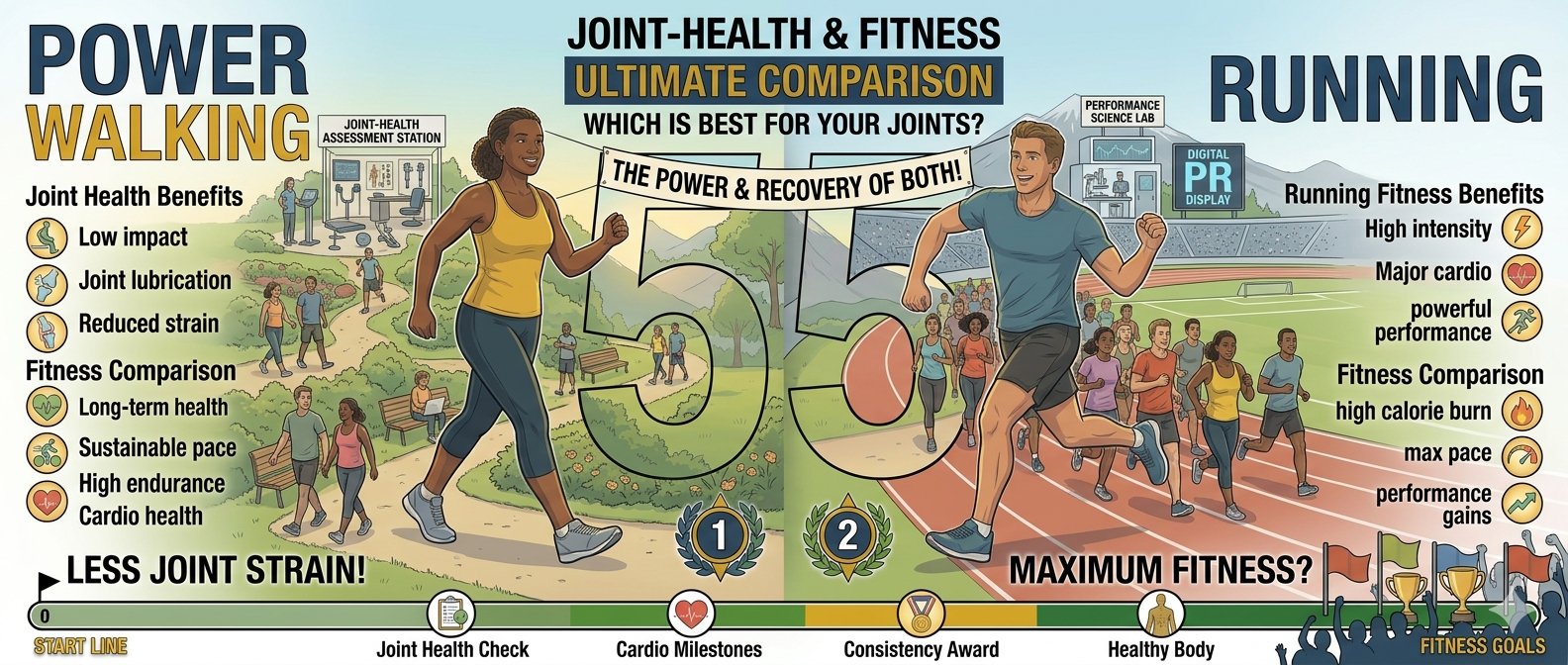
When an individual makes the bold choice to elevate their cardiorespiratory fitness, improve their endurance, and maximize their physical health, they almost always find themselves facing a classic debate: Should I choose running or should I stick to power walking? For decades, mainstream fitness culture has pushed the idea that running is superior, labeling walking as a casual activity reserved exclusively for recovery days or older populations.
However, sports science and biomechanics tell a completely different story. While running is undeniably an elite tool for burning high amounts of calories quickly, it places an immense mechanical tax on the human skeletal chassis. Conversely, power walking—executing a fast walk at an aggressive pace above 6 kilometers per hour—delivers nearly identical cardiovascular and metabolic rewards while presenting a fraction of the structural injury risk. To help you choose the absolute best movement pattern for your unique joint architecture and long-term fitness goals, this analytical review evaluates both forms across five critical parameters.
1. Biomechanical Impact Forces: The Mathematical Breakdown
The primary difference between power walking and running lies in the physical forces transmitted through your lower body joints with every single stride.
- The Running Impact Matrix: When you run, your movement pattern includes a distinct airborne phase where both of your feet leave the ground completely. When your foot strikes the hard asphalt to land, your body must absorb a sudden, violent vertical shock wave equal to 3 to 4 times your total body weight. This compounding force travels directly through your ankle tendons, tibia bone, meniscus cartilage, patella knee joint, and lower spine discs. Over a standard 5-kilometer run, your body absorbs thousands of tons of crushing force.
- The Power Walking Matrix: Power walking features zero airborne phase. One foot remains firmly anchored to the earth at all times, creating a smooth, rolling transition of weight. The impact force generated during a power walk landing stays capped at a highly safe 1.2 to 1.5 times your body weight. This low mechanical load makes power walking the undisputed king for individuals recovering from joint issues, carrying excess weight, or looking to protect their cartilage as they age.
2. Caloric Output and Fat Oxidation Efficiencies
Many people choose running simply because it burns more total calories per minute. While this is mathematically true, analyzing what kind of calories are burned reveals a fascinating metabolic reality.
| Exercise Format | Total Caloric Burn (Per 30 Mins) | Primary Energy Fuel Source | Glycogen Depletion Level |
| :--- | :--- | :--- | :--- |
| Running (9.5 km/h) | ~350 - 400 Calories | 70% Carbohydrates / 30% Fat | High (Triggers rapid hunger spikes) |
| Power Walking (6.5 km/h)| ~220 - 260 Calories | 40% Carbohydrates / 60% Fat | Low (Maintains stable energy metrics) |
Running requires high energy output, forcing your metabolism to rely heavily on fast-burning sugars (glycogen). Once your run ends and your glycogen tanks are empty, your brain triggers intense hunger signals, making it very easy to overeat. Power walking keeps you locked inside the aerobic zone, drawing heavily from fat stores while leaving your blood sugar stable, which naturally suppresses post-workout appetite spikes.
3. Structural Injury Risk Profiles: Keeping Your Body Bulletproof
To properly analyze any fitness routine, you must look closely at its long-term safety profile. A workout cannot improve your health if it keeps you stuck on the couch recovering from an injury.
Clinical sports medicine statistics demonstrate that up to sixty percent of regular runners face an overuse injury every single year. The constant pounding of running frequently triggers acute shin splints, painful plantar fasciitis, and patellofemoral pain syndrome. Power walking injuries, on the other hand, are incredibly rare and typically limited to minor skin blisters or temporary calf tightness. This exceptionally low risk profile makes power walking a highly sustainable, lifelong habit you can execute daily without requiring long recovery gaps.
4. Cardiovascular Conditioning and Lung Capacity Growth
Does power walking do enough to strengthen your heart and expand your lung volume? The answer is a definitive yes, provided you maintain proper intensity.
If you push your power walking speed into a fast pace where your breathing quickens and your skin breaks into a light sweat, you are entering the zone of moderate-intensity cardiorespiratory exercise. Training at this pace actively expands your stroke volume—the total amount of blood your heart can pump with every single beat—while clearing plaque out of your blood vessels. Running will elevate your peak VO2 max score faster, but power walking achieves the exact same long-term heart-health benefits and blood pressure reductions without forcing your body into states of extreme physical stress.
5. The Verdict: How to Select Your Ideal Movement Pattern
Ultimately, choosing between power walking and running requires a smart evaluation of your current physical baseline, body weight, joint health history, and personal lifestyle preferences. If you are an athlete with healthy joints and want to maximize speed and raw athletic power, running is a phenomenal choice.
However, if your primary goals are sustainable weight loss, mental stress reduction, long-term joint health, and daily consistency, power walking is an absolutely elite choice that sports science supports completely. Do not look at walking as an inferior activity; when done with high intensity and proper biomechanical form, power walking is a world-class endurance workout that builds a lean, healthy body while fully protecting your joints for life.
 Back to Blog