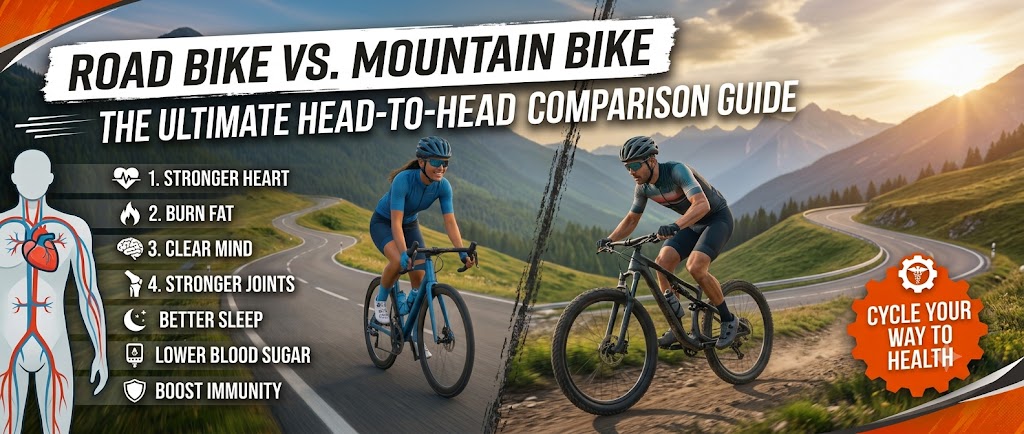
When an individual decides to step away from indoor gym equipment and invest in a high-quality outdoor bicycle, they immediately find themselves facing a classic choice: Should I purchase a high-speed Road Bike or a rugged Mountain Bike (MTB)? Buying the wrong bicycle architecture can ruin your riding experience, leaving you with a machine that is completely mismatched for your local roads and personal fitness goals.
These two bicycle classes are highly specialized mechanical tools engineered for entirely opposing environments. A road bike is built for maximum speed, aerodynamic efficiency, and long-distance endurance on smooth asphalt pavement. Conversely, a mountain bike is built to conquer rough dirt trails, loose gravel paths, steep rocky inclines, and deep forest roots. To help you make a fully informed investment matching your budget and lifestyle, this technical guide evaluates both platforms across five core mechanical parameters.
1. Frame Geometry and Riding Posture
The physical shape of a bicycle frame dictates exactly how your body sits on the machine, influencing both your aerodynamic drag and structural muscle comfort.
- The Road Bike Configuration: Road frames feature an aggressive, stretched-out geometry. The handlebars sit lower than the saddle, forcing your torso down into a low aero tuck position. This minimized forward profile dramatically cuts wind resistance, allowing you to move fast with less physical effort. While highly efficient for speed, this position requires good core strength and lower back flexibility.
- The Mountain Bike Configuration: MTB frames feature an upright, relaxed geometry. The handlebars are wide and positioned high above the saddle level. This design places your body in an upright stance, maximizing your line of sight and lowering your center of mass. This posture delivers the high stability and fast steering control needed to navigate tricky off-road obstacles safely.
2. Suspension Systems and Impact Shock Absorption
How a bicycle manages bumps, potholes, and rough terrain relies heavily on its built-in suspension engineering.
| Bicycle Category | Suspension Architecture | Mechanical Purpose | Impact Capability |
| :--- | :--- | :--- | :--- |
| Road Bike | Completely Rigid (No Suspension) | Maximizes power transfer from pedals to rear wheel | Low (Passing bumps directly to rider) |
| Mountain Bike (Hardtail) | Front Suspension Fork (100-120mm travel) | Absorbs trail impacts while maintaining light weight | Medium (Ideal for dirt paths and light rocks) |
| Mountain Bike (Full-Suspension)| Front Fork + Rear Mid-Frame Shock | Keeps both tires glued to extreme rocky terrain | High (Built for downhill roots and drop-offs) |
Road bikes drop heavy suspension components to save weight. They rely entirely on carbon fiber forks to dampen minor road vibrations. Every ounce of energy you press into the pedals travels straight to the rear wheel without any loss through suspension movement. Mountain bikes use sophisticated hydraulic suspension systems to absorb hard ground hits, keeping your wheels grounded and your body protected over rough trails.
3. Wheel Sizes, Tire Profiles, and Traction Dynamics
The point where your bicycle contacts the ground dictates your rolling resistance, stability, and grip.
Road bikes roll on narrow 700c wheels wrapped in super-thin tires (typically 25mm to 30mm wide). These tires feature slick treads and run at high pressures, reducing rolling friction to an absolute minimum so you glide fast over asphalt. Mountain bikes utilize wide 29-inch or 27.5-inch wheels wrapped in thick tires (2.2 to 2.6 inches wide). Operating at low pressures with aggressive tread knobs, these tires expand your contact patch to deliver elite grip across loose dirt, sand, and slick mud.
4. Drivetrain Configurations and Gear Ratios
Modern bicycle gear setups are carefully tuned to match the unique speed profiles of their target environments.
- Road Bike Drivetrains: Typically feature a double chainring setup in the front (2x) paired with a tight 11-speed cassette in the back. The gear ratios are close together, allowing you to make small adjustments to match your exact pedaling cadence perfectly on flat roads and long climbs.
- Mountain Bike Drivetrains: Utilize a modern single chainring setup in the front (1x) paired with a massive 12-speed rear cassette featuring a huge 50T or 52T climbing cog. This ultra-wide gear range provides the extremely low gear ratios needed to crawl up incredibly steep, loose off-road hills without losing rear wheel traction.
5. The Verdict: How to Choose the Perfect Bike
Selecting your ideal bicycle requires matching your local geography with your personal fitness goals. If you want to log long endurance rides, participate in fast group rides on the highway, and maximize your speed and cardio fitness, a Road Bike is your premier choice.
However, if your local roads are filled with deep potholes, or you want to explore dirt trails, forest paths, and mountain environments safely without worrying about flat tires, a Mountain Bike is the clear winner. If you want a middle ground, consider a modern Gravel Bike, which blends a road bike's speed with a mountain bike's trail capability. Define your riding environment clearly, invest in a quality machine, and enjoy the infinite freedom of outdoor cycling.
 Back to Blog